Read the text below. The text has six paragraphs (A – F).
Our Fascination with Mars
| A Mars, the fourth most distant planet from the sun in our solar system, is actually more than one place. There’s the Mars that scientists study through telescopes and with robotic satellites and rovers, the destination in our solar system that astronauts will someday visit and colonise. There are also other versions of Mars, which have come from our imagination, throughout the course of history. | 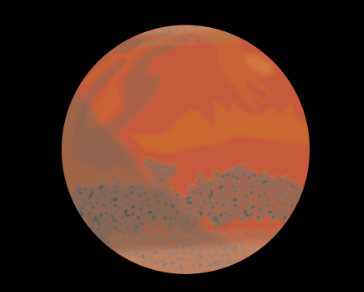 |
B Mars is one of five planets which are visible to the unaided eye. Its reddish-orange hue inspired some civilisations in the past to imagine it as a symbol of war and violence. The ancient Mesopotamians linked Mars to Nergal, a god who was the symbol of hunting, and sometimes led the other gods into battle. In their city of Nineveh, they erected the Nergal Gate to show their reverence. The ancient Greeks associated the red planet with Ares, the warrior god who was the son of Zeus and his wife Hera. In Roman mythology, Ares became the war god Mars, who was so important to them that they dedicated March, the first month in their calendar year, to him. C Eventually, people started shifting from thinking of Mars as a mystical place to seeing it as a planet that was somewhat like their own. The development of telescopes in the 1600s enabled humans to see Mars and some of the details of its surface clearly for the first time. In 1659, the Dutch astronomer Christian Huygens drew one of the first accurate maps of the red planet, and figured out that it rotated in the same way that Earth did. D In 1877, the Italian astronomer Giovanni Schiaparelli observed lines in the planet’s equatorial region, a phenomenon that also was noted by the American astronomer Percival Lowell. The term that Schiaparelli used – canali – sounded a lot like the English word canal, and that led some to mistakenly think that the red planet had waterways built by an alien civilisation. E Even after other scientists concluded that Mars’ surface was probably not capable of supporting life, the idea of life on Mars fascinated people’s imaginations. Writers of the new genre of science fiction and fantasy began to write about it in their stories. British author H.G. Wells’ pioneering novel ‘The War of the Worlds’ depicted Mars as a dying planet whose technologically-advanced civilisation wanted to conquer Earth. It caused a sensation when adapted for a radio broadcast in 1938. ‘The Martian Chronicles’, Ray Bradbury’s 1950 collection of stories, presented a planet filled with empty cities from a fallen civilisation. For Hollywood filmmakers, Mars also became a convenient setting for movies full of malevolent Martians and monsters, such as the 1960 film ‘The Angry Red Planet’. There was even a television sitcom, ‘My Favorite Martian’, which featured a sarcastic secret visitor from Mars who pretended to be human. F All these sci-fi fantasies of Mars were dashed by the close-up images transmitted by the Mariner 4 unmanned space probe in 1964, which revealed it to be a cratered, moonlike planet, lacking in seas or vegetation. Those and later scientific discoveries about Mars seem to have influenced writers and filmmakers to change their depictions of the red planet – not as home to an alien civilisation, but a distant world that humans will someday visit and colonise. In more recent movies such as 1990’s ‘Total Recall’ and ‘The Martian’ in 2015, Mars is depicted as a rugged, barren, dry planet with a thin atmosphere, where space colonists have to live in well-protected bases and wear spacesuits to survive.