Read the text below. Then answer the questions opposite.
First experience of Bombay
A factory is going to be built in Thul, a small fishing village in India. The villagers fear it will change their traditional way of life, so a group of them, led by Adarkar, go to Bombay1, to protest. The story is told from the point of view of Hari, a young boy who goes with them.
Here they have just set off in boats from Rewas to Bombay.| (1) By the time the sun was up, turning the dull sea into peacock blue and emerald green and lighting up the city of Bombay on the far shore, like a white castle made of sand, or salt, blinding against the hot blue sky, all the boats had been loaded and were setting out like a shoal of dolphins over the waves. (2) It was fourteen kilometres from Rewas to Bombay. All the way they shouted and sang. Their voices rang from boat to boat. They were all in high spirits; it was such a rare outing for them who usually never gave up a day’s work to leave their villages, it seemed almost like a holiday. Adarkar had to shout occasionally to remind the farmers and fishermen why they were going to Bombay. His voice was getting so hoarse, one of the older fishermen finally tugged at his shirt, hanging out over his dhoti2 and wet with perspiration, and said, | 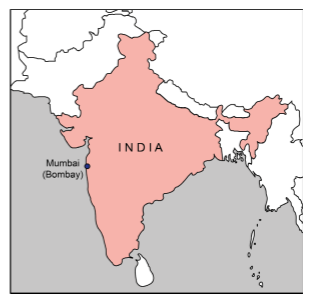 |
(3) “Sit down, son, sit for a while. Keep your breath for all the shouting you are going to do in Bombay. When we get there, we will shout so every man in the city hears us, never you fear. Sit and have a little rest. Give our brother some tea to drink,” he called to the men in the boat. One of them produced a clay cup which was still half full of tea, the rest having spilt earlier. They passed it to their leader who sat down and drank gratefully. Another produced a sweet lime, peeled it and passed him the segments to suck. He was grateful to them and took their advice.
(4) Hari, who had bought neither tea nor fruit at the pier nor food from home, sat very quietly on the floor of the boat and no one paid him any attention at all. There was no one else from Thul in his boat; it was full of strangers from other villages along the coast, and he sat listening to them feeling very hot, tired and thirsty, and very afraid of the journey he had undertaken, without thinking, simply because he had been upset and angry and simply could not bear to live another day in Thul in the old way. The time for change had come, he had felt that. He had had to make the break he had been thinking about for so long. Had he done wrong? (5) He was silenced by awe when he saw the city of Bombay looming over their boats and the oily green waves. He would have liked to stand and stare as he disembarked from the boat at the Sassoon docks, aching and stiff from the long ride in the jam-packed boat, but there was no time. His fellow passengers were pushing and shoving past him and he was carried along by them. They pushed and shoved because they were in turn being pushed and shoved by the Bombay crowds that thronged the docks – so many people in such a great hurry as the villagers had never seen before. It was only out of the corner of his eye that he saw, briefly, before being pushed on, the great looming sides of steamships berthed at the docks, cranes lifting and lowering huge bales, men bare-bodied and sweating carrying huge packing cases and baskets on their heads and shoulders, grunting as they hurried, women like the fisherwomen at home with their purple and green saris tucked up as they ran with baskets of shining, slithering fish from the boats to the market, straw and mud and fish scales making the ground dangerously slippery. (6) And now they were out through the gates and on the street and in the midst of the terrifying traffic. In all his life Hari had not seen so much traffic as he saw on that one street. In Thul there was only the occasional bus driving down the main road of the village to the highway, and very rarely a single dusty car. He clutched the arm of the man next to him in alarm and then was relieved to find it was a farmer, Mahe, from Thul. (7) “Hurry, brother – we have to go to the Kala Ghoda, the Black Horse,” Mahe panted, and together they dodged the traffic and ran into a huge red double decker bus that screeched to a halt just before their noses. The driver leant out of the window and bellowed at them. They stood transfixed, shaking. Then the police appeared. “Where have you come from, fool?” the policeman roared at Hari. “Never seen traffic lights? Don’t you know how to cross a street? Come straight from the pumpkin fields, have you?” The policeman laughed, held up his hand to keep the bus waiting and waved to the marchers to cross the road. “We are farmers and fishermen from Alibagh,” said Mahe quietly before he moved on. “We have come to speak to the Chief Minister.” “You do that,” the policeman told him. “You do that – he is waiting for you with tea and a garland and a sweet for each of you.” He burst out laughing again, winking at the bus driver as he did so, and then blew his whistle shrilly to make them move. Hari and his companion moved on, very hurt and offended. “These Bombay-wallahs, the rudest people on earth,” muttered Mahe, and Hari nodded.1 Bombay is the old name for Mumbai
2 A loose piece of clothing wrapped around the lower half of the body, worn by some men in South Asia